News
Results
From MIT to IBM, expediting AI and quantum deployment
MIT affiliates engage with the MIT-IBM Computing Research Lab to bring rigorous theory to production systems.

System helps humans predict when self-driving cars will make mistakes
A new method, called CW-Net, translates the reasoning process of an autonomous vehicle’s AI system into understandable concepts that explain its behavior.

Atlas of the brain’s striatum could guide researchers to new drug treatments
A new study reveals insights into populations of neurons affected by Huntington’s disease, schizophrenia, addiction, and other disorders.

How an MIT research project became a global programming language
With millions of users across the world, Julia has been used to conduct cutting-edge research and to design new drugs, jet engines, heat pumps, and more.

New type of attack can slip past the defenses in your computer’s processor
MIT CSAIL researchers found a way to exploit a split-second gap in chip security — and used it to acquire a Linux system’s password file.

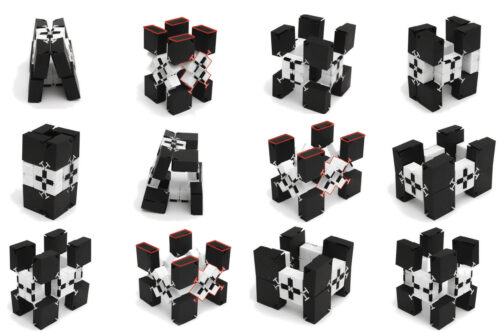
MIT engineers create a system for building shape-changing smart devices
Dubbed “bifur-circuits,” these interactive building blocks could be used to develop reconfigurable robotic grippers or customized assistive devices.
Generating scenarios for extreme events, without extreme data
A new algorithm learns to anticipate the unprecedented scenarios that critical infrastructure and global supply chains are least prepared for.

Securing wireless communication in next-generation devices
A new, scalable technique could enable powerful radars and sensors based on quantum technology that works at room temperature.
When AI art has no author: Study finds generated images often can’t be traced to training data
A new method for surgically removing training examples from a model reveals that as datasets grow, the link between what a model learns and what it produces dissolves.

Mathematical framework connects biological principles to manufacturable, adaptive materials
The new framework could streamline the design process of robotic grippers or aerospace components that exhibit complex behaviors found in nature.